

Special “WATCH YOUR BIDS” podcast edition with BCA Research’s Marko Papic.
I was fortunate to grab 25 minutes of Marko’s time and discuss whether the market has become so efficient at geopolitics that the old “buy at the sound of geopolitical cannons” has broken.
Podcast is embedded at top of post.
Learn more about BCA Research here:

Check out Marko and Jacob’s podcast, Geopolitical Cousins, here:

And finally, if you want to receive more updates from the MacroTourist, sign up here:
Recorded Friday night, March 6th, 2026
Transcript:
Kevin: Here we go. Hey, folks, welcome to the special edition of the Macro Tour’s Watch Your Bids podcast. It’s Friday, March 6, 2026 at 7 p.m.
I have a real treat for you guys this week. Recently, Dario Perkins, the managing director of Global Macro at T.S. Lombard, quoted a piece that I wrote about the market not fully appreciating the enormity of the geopolitical situation. Although I had referenced Marko Papic earlier in the post, in the tweet, there was no reference to the famed geopolitical strategist at all. Well, Marko’s ears must have been burning because he responded, “I feel partly responsible for what Kevin is saying. When World War Three starts and nobody is positioned correctly, they’ll blame my book the way they did with The Great Illusion.”
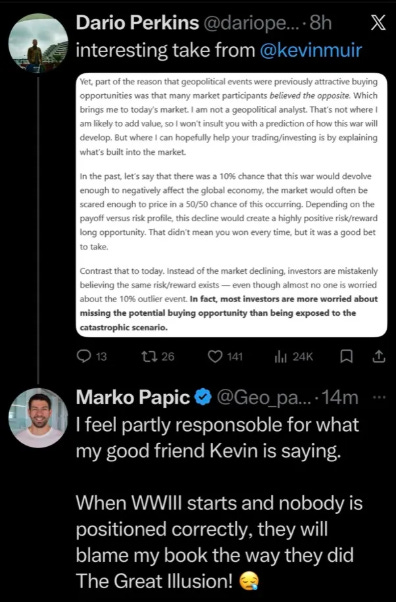
For those who don’t know (and I was one of them), The Great Illusion is a book written by Norman Angell in 1909, which stated, “The economic cost of war was so great that no one could possibly hope to gain by starting a war the consequences of which would be so disastrous.” Well, I certainly wasn’t blaming Marko, but I do feel that at least when it comes to geopolitical events, he is one of the architects responsible for making the market more efficient. And that’s a good thing. However, I might suggest that it’s become so efficient, it’s now a fade (trader speak for taking the other side). All right, enough with the introduction. Grab a beer, sit back and enjoy the legendary Marko Papic from BCA Research.
Kevin: All right, it’s my great pleasure to welcome to the show an old buddy, a fellow Canadian — although he’s left me for warmer pastures in L.A. Marko Papic. Marko, thanks for making time for me.
Marko: Kevin, it’s a pleasure, buddy. I wish I was drinking a beer, though.
Kevin: Now, I know you must be a guy that is in high demand right now. Everyone wants to learn about the markets and the geopolitical aspects of this. But I want to talk about something different than what other folks are probably going to be asking you. Most people will want to know what do you think is going to happen with the with the Iran situation. And for anyone who’s interested in what you think on that aspect, I really highly encourage you to go to your podcast, Geopolitical Cousins with our buddy Jacob. You guys do a terrific job. You’re doing all sorts of special, quick updates and things like that. So that’s where you should go for learning what Marko thinks. But what we what I’d like to talk about today is how the market has changed. And I’m going to suggest to you that you are a victim of your own success.
And I’m going to tell you why. I think that your book, Geopolitical Alpha and kind of the concept that you often would drill into my head and something that I was very sympathetic to was that the market always, or often, overreacts to these sorts of events. I think that now you’ve kind of convinced so many people of that the market is not even reacting.
Marko: Well, I mean, you know, on one hand, I’m like, bro, on the other hand, I’m like, thank you. Yeah, you’re basically I’m the Norman Angell of our era. You know, like humbly, humbly put humbly put, I think you are right. I’ve got a dear client of mine who hopefully is listening to this. A really, really smart allocator. One of his team members said, you know, my boss told me that you would fade your own death. In other words, you know, if you die, you’d be like, nah, I’m just I’m just resting. It’s not over.
So, yes, I think the whole point of geopolitical alpha, you know, the whole point of geopolitical alpha is basically that quantitative work and empirical work I’ve done is really, really clear geopolitical events. It’s not it’s not rarely it’s like never actually have a lasting impact on the market. And there’s really two reasons for that, Kevin.
One, the market always overstates the risk. It always starts to trade what’s possible instead of what’s probable. So no one’s there to talk about material constraints through the potential apocalypse.
But the second issue is that even if things get pretty dire, the reality is that the event itself gives policymakers an excuse to, you know, pivot, to stimulate, to cut rates, to do fiscal, to, you know, like maybe say, oh, maybe that wasn’t a great idea. So there’s also that kind of a pivot and reflexive impact. So, yes, I think that the market is getting smarter because we are now in a geo macro environment. You know, we’re not in a macro environment anymore. If your skill set is like reading FOMC minutes, like good luck next 10 years. So the market, given that, you know, Marko Papic is not some sort of a genius, like anyone can kind of figure this stuff out. I think the market is now starting to definitely get better and better at this. But you’re right.
Now the question is, has it has the pendulum swung to the other side too much?
Kevin: OK, so what do you think? Because like I look at it and I kind of remember that quote from Ed Seykota and he says; “the markets are the same now as they were five to 10 years ago because they keep changing just like they did then.” And one of the things that I truly believe is that as markets begin to understand stuff, they price it in and therefore then you need to adapt and assume that, OK, they understand this. So I need to be one step ahead. Are we now at the stage where geopolitical risk is actually maybe a sell because there is zero priced in? And I might even suggest to you that so many people know your work, and like, you know, showing me the chart that you have there of showing like after the event that it goes up and something that they’re actually buying it before there’s even a dip.
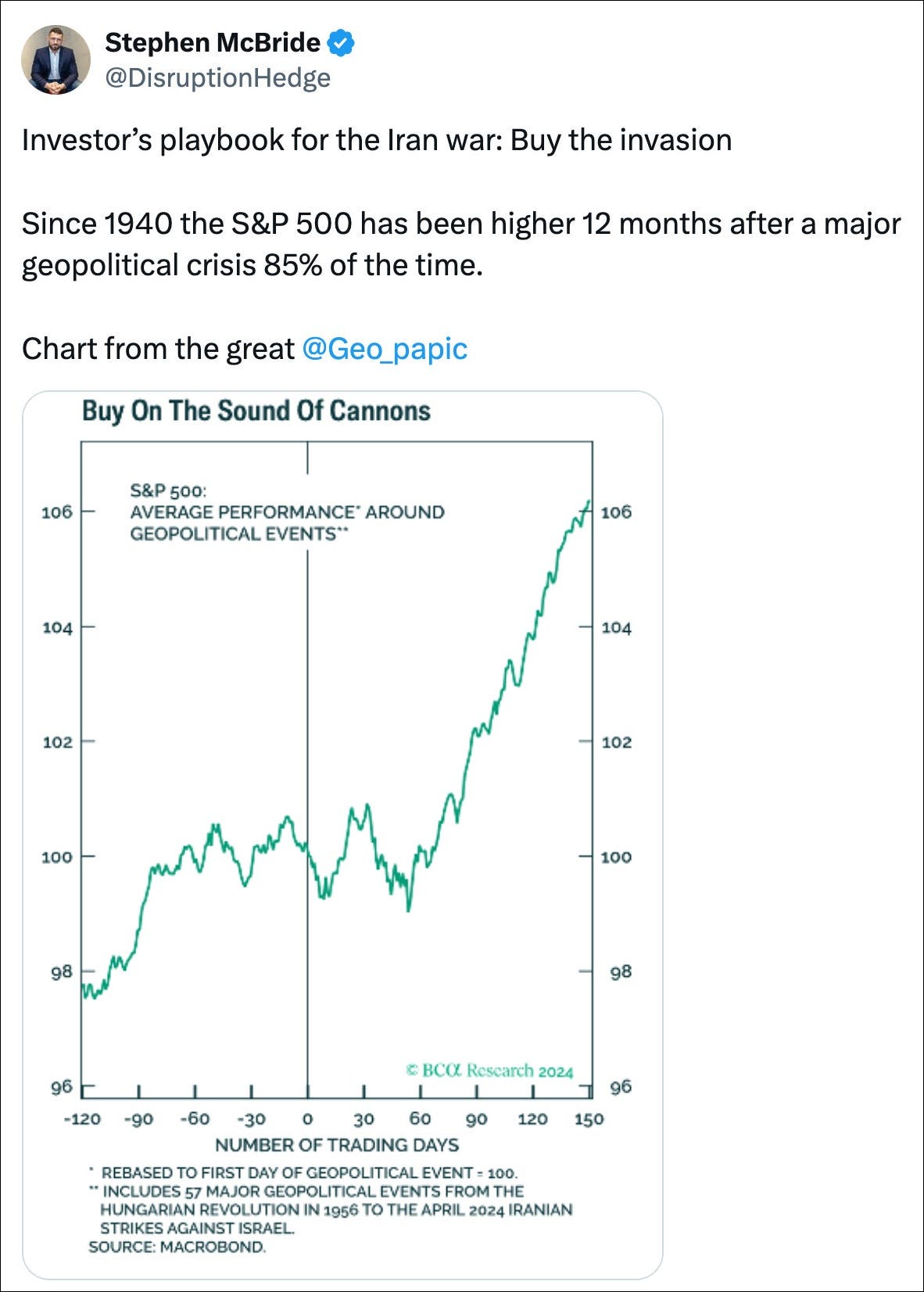
Marko: So so many so many things to unpack there. So first of all, I work for a firm called BCA Research and it’s a 77 year old gem, Canadian gem, 77 years old, started in 1949 by Hamilton, Bolton and then stewarded for decades by the great Tony Boeckh, in old Montreal.
Kevin: We had him on the show by the way.
Marko: Well, that’s amazing, of course. I mean, you guys are both Canadian macro legends. So it makes sense.
Kevin: Don’t think that, buddy.
Marko: No. So like, look, why why do I bring this up? I bring this up because what does the acronym stand for? BCA stands for bank credit analyst.
Like none of us are doing bank credit analysis anymore. And that’s exactly what you’re saying. If you’re going to survive for 77 years in macro, you better be incorporating different frameworks all the time. And we had BCA Research decided, you know, to give credit to one of our past CEOs,
Bashar Al-Rahani. He came in and he was like, you guys sit around this boardroom table all day and anytime something is political or geopolitical, you just say, well, that’s not what we do. So we’re not going to cover it. And so in 2011, you know, they brought me on board. I started that service. Now it’s run by my dear friend Matt Kirk and who runs a geopolitical desk. What I do is I do geomacro. And that’s the synthesis between macro and geopolitics, which I think is not a synthesis anymore. I think if you’re not taking geopolitics to be endogenous to your process, I don’t think you’re a macro investor. Now, to your point is, has this gone too far? I absolutely it’s not that it’s gone too far. It’s that people,
you know, like if you read my book, it’s not like my book is a pamphlet that says, “$$#&^$ geopolitics, quantitative data shows it, mic drop, goodbye.”
It’s a book. It’s a book. And what the book basically says is, you know, like most of the time investors overstate or understate the material reality that’s actually constraining policymakers. I think what is the problem is that now folks out there, investors, traders, and especially retail guys, you know, they think that this is a hack.
What they don’t understand is that they still have to do the geopolitical analysis.
So, yes, yes, last year I absolutely just, you know, was autopilot and definitely told my clients, don’t go long oil because of Israel Iran nonsense.
I literally told my clients that two countries can nuke each other and it won’t affect the rest of the world at all.
But that’s because your eye should always be on the prize when it comes to the Middle East. The fulcrum at which everything matters is the Strait of Hormuz.
So if Israel and Iran want to have a 20 year war where they law ballistic missiles at each other, God bless them, like it’s cool, you know, rock your boat, go ahead, do whatever you want.
And that was the case in twenty five. What changed in December, though, Kevin, and the reason that I’ve been recommending a long oil position, long rents is January 6th.
The reason this changed, the reason that this time I wasn’t that sanguine is that the Iranian regime is now existentially threatened and it’s not existentially threatened from Israel. We’re basically the Gulf Arab oil producing states have plausible deniability.
It makes no sense for Iran to attack those states and then put them on Israel’s side. No, no. This time, United States of America used the R word regime change. OK, you know, and the regime itself was undermined in December with internal discord, which we should also point out. So I think that it was different this time. I wasn’t fading geopolitics this time around.
And in fact, this week has been very difficult for me, Kevin, because of my framework, which pulls me to fade.
But I fear that what investors are underestimating is this technological asymmetry where, yes, Iran may not have the ability to defend itself, but it may have the ability to impact shipping with drone technology. And we saw the Houthis do the same in the Red Sea with even less technology. So so that’s why what I would explain and what the way I would explain the framework is there is nothing automatic or supernatural about fading geopolitical risk. It’s based on a framework that focuses on material constraints, but you still got to understand those constraints and do the work.
Kevin: Oh, so I completely agree. I understand what you’re saying. Terrific call. But one of the things that concerns me about this, though, is that because we’ve had so long that it was such an easy fade, the markets are actually set up in a much more dangerous way right now in that I think so you would agree with that. You would from like a game theory perspective, like, you know, people are over their skis long expecting this to resolve easily.
Marko: Yes, except I do think oil prices, you know, so had a very, very tough week on this issue, really meditating, talking to my clients who know how to trade much better than I do. I mean, you know what I do, Kevin, I’m at the beginning of the assembly line of our profession. You’re further downstream, you know, so like I’m like the architect who designs the house and then the contractor looks at it and goes like, what the hell is the architect thinking? You know, you’re like, that’s not how you do a deck, you know, and then and then they actually make it happen. So from a trading perspective, it’s difficult. And I do think that, you know, my recommendation, we should start taking some profits on oil.
You know, on oil, I do think we’ve had a move. What you’re pointing out, however, the S&P 500 risk assets have been asleep at the wheel.
And I think I would add to that.
The macro setup is more pernicious than last summer. And what I mean by that is that there’s a lot of cockroaches in the private space that nobody really knows where they’re going to end up.
Excuse me. You’ve had this very interesting dynamic with the labor market report that came out. So jobs report today on Friday, March 6th. And so I do think that the setup in the markets where S&P 500 has gone over since October could also add to the downside. So I agree with you.
Kevin: Yeah. Well, I was looking at it yesterday, Marko, and I was looking at how much the S&P was off like this week. But, you know, as of Thursday’s close, I think the S&P was off 0.68%.
And I kind of laughed and said that the market got more and more upset with a supposedly hawkish central bank choice than they did with the potential of World War III.
Marko: Well, they got they got more hawkish. You’ve got more bearish because of a blog post by our good friend Citrini. You know what I mean? Like, yeah.
Kevin: So so I think that’s that’s that’s you. You’ve you’ve taught them all of this. And everyone’s like, oh, nothing happens. And I’m not blaming you.
Marko: I’m saying that I love it. It’s notoriety. Kevin, listen, like all publicity, all publicity is good publicity. I’ve flattered that you think that I’ve created a setup for a very complacent market. And I think, again, in the tools of somebody who doesn’t do the analysis, it does lead to complacency.
There’s a meme. There’s literally there’s literally a meme out there where it’s like a little political cartoon of like a a mom serving like really nice dinner to privileged kids living in a beautiful house. And the boy says, Mommy, Mommy, how did we get so rich? And the mother says, oh, you’re when something that happens, your dad does nothing. You know, so I have I have created that myth. You know, like that’s great. I don’t disagree with you.
But again, what underpins the myth is the framework and the analysis. And sometimes when you do the analysis and you say to yourself, wait a minute, in this particular case, do the material constraints mean that President Trump will taco? The answer is is absolutely yes. Here is where. But here’s where it’s not just my fault. It’s also President Trump’s fault. And what I mean by that is that he has conditioned us to believe that when he when he pivots, when he lands the plane, I don’t actually like the term taco. He doesn’t really chicken out. He gets a deal. OK. And the deal, you know, the deal doesn’t get him to the moon, but he gets to go to the top of his house.
And, you know, it’s like whatever marginally better than before. But the problem in this case is that folks are not doing the game theory.
They’re just looking at Trump and they’re saying, OK, Marko’s framework of fading geopolitical risk has worked because President Trump has landed the plane in his negotiations every single time. You know, he he gets Peter Navarro to go out there and say, no, there’s no negotiations and tariffs. And then what do we do? We negotiate. OK.
The problem is that the folks who are trading this the way they’re trading it right now is that they haven’t set up the game theory. Properly. In other words, there is a counterparty. And in this particular case, the counterparty is not, you know, the well-heeled Mark Carney of Canada. It’s not, you know, the really nice, you know, NATO member states. It’s not even Xi Jinping of China.
It is the Islamic Republic of Iran. And while in every previous situation where President’s delicious taco was eaten whole by his counterparts in this particular case, the Islamic Republic might say, you know what? Take your taco and shove it, you know, exactly where you should shove it. Yeah. And that’s the problem in this game. That’s where the risk is. Right. That’s what I don’t think folks have done fully the geopolitical analysis necessary. Geopolitics is not an ornament.
It’s not, you know, it’s not a gear shift with two gears. It’s an analytical tool that has nuances to it. And we have to do the, you know, we have to make bets on those nuances and yes, they can go up and it can go down.
Kevin: Yeah, I completely agree. And that’s what I keep saying. I said, like, I fully expect him to taco or, you know, as you say, come up with a deal like he’s I think that we’re going to get a mission accomplished and, and everyone’s going to get excited about it. But I don’t know if the Iranians will be so quick to accept that that it’s all back to normal.
Marko: So let me let me both agree and counter to you. So I’ve told my clients except expect a double top in oil kind of in a in a double bottom, I guess, in the S&P 500.
What I mean by that is I think at some point, President Trump, of course, lands the plane. He lands the plane on this tacos, whatever you want to call it. And then I do think that this is where the game theory comes in. I believe that if I was running Iran, I would not eat the taco.
I would say I need to update the utility function of the West.
So they don’t attempt this nonsense for the next 50 years. I need to remind them because apparently they have forgotten why straight from whose matters and why. Well, I may not be able to defend the eyes, the skies across Tehran.
I can’t use simple drones to close the straighter from us. And so, yes, there is, as you suggest, this period during which the Iranian regime may have to actually say we don’t want to necessarily play your game. Now, during that period, why do I not expect that to last one year or five years or 10 years? Why do I expect it to actually last just mere days?
Because you are kind of facing off. You’re in a Mexican standoff against the largest military force ever assembled.
Like the United States military is not going to invade you. They’ll turn you into an economy sized like parking lot outside of a airport. And so you do have to show again as a regime that you’re willing to take that in the face. You want you’re going to take that pain. You’re going to take that punitive campaign. And when I say punitive, Americans are not going to go after their ships and their missiles. They’re going to go after their water treatment facilities.
Like the United States of America is going to take the gloves off and start degrading their ability to exist as a post-medieval state. They’ll take them back to the opposite caliphate for those five, six, seven days. And again, Iran still has an interest in taking that pain and illustrating to the rest of us. Well, look, if you threaten our regime, we’ll do this. I don’t think I can last that long, though. And that’s that’s why I think that there is kind of a double bottom in risk assets, double top in oil, potentially.
That’s why I’ve recommended to my clients that they take profits if they took my recommendation on January 6th on Brent, like take profits on it. Not all of it, but like half of it.
Yeah.
And then and then wait for Iran to taco, because I think in this particular case, it’s not
President Trump that we have to wait for. It’s really Iran.
Kevin: OK, we’re going to wrap this up because I promised I was going to keep you long. Just two quick questions for you. First, does Trump land the plane, as you like to say without the stock market going down? Because, yes, crude’s gone up and that is obviously painful, but it’s less painful for the U.S. than a lot of the rest of the world.
It’s obviously Trump does not love it. But realistically, do we need the stock market to be down 10, 20 percent like the like Liberation Day before he truly is interested in landing the plane?
Marko: I think it certainly would help increase my conviction that the pivot from Trump is coming.
Yeah.
But I do think that the White House is having the same discussion we are, Kevin.
You know, because what we’re having is an epistemological ontological discussion.
OK, you know, this is like a philosophy of knowledge.
And so I bet you that they have this exact same conversation where someone in the White House, like Pete Hegseth you know, I bet he would say something like cut the track. Let’s be real here. Everything is good. Stock market’s up. I just did 47 pushups. And the Trump is like, yeah, I agree. Stock market’s up. Let’s keep going. And then Scott Bessent says, no, it’s my buddy Marko who’s been like playing the markets and now everybody is basically a fading degenerate nihilist serve.
So let’s pump the brakes on everything being fine, you know, which is what you’re saying. Like you’re like, my buddy Marko has broken the market, you know. And so I do think that inside the White House, someone’s going to say, look, President Trump, the market is, you know, basically kept kept strong. It’s kept stable by deejans expecting you to fade. And the problem is that the underlying mechanics that actually matter for your election, which is not necessarily the S&P 500, the labor market, oil prices, angst over inflation, they’re actually getting red hot, even if that front burner of the stock market is not flashing red. So I don’t think if you and I are having this discussion right now, I don’t think it’s going to be that difficult for other people to say the same things, which is that the S&P 500 is disconnecting from all of the pillars that that do matter, all the factors and variables that will impact his, you know, parties, reelection chances, chances in midterms, his legacy, his ability to hold on to various, you know, awesome contracts that he’s going to receive as the president, all the deals he’s made. You know, I do think that those things do matter. Legacy matters. And I and all you’re saying, Kevin, is that the S&P 500 is no longer really connected to reality. I think they can connect those dots as well. OK, maybe not all cabinet members like let’s not be generous to everyone.
Kevin: Last question for you. When you go talk to your clients, are you finding it strange that you’re on the other side? Like usually you’re you’re talking them off the ledge. In this case, you’re actually trying to talk them back onto the ledge.
Marko: You know, yeah, in January I did.
I mean, a lot of them told me, but Marko, you were so adamant that we should fade this Middle East stuff for the past two and a half years. Since October 7th, 2023, you’ve been telling us it doesn’t matter. And my point is like, well, when facts change, I fact I change my view. Yeah, if I had been telling you since October 7th, 2023 that that hamas attack would lead to the breakdown in the Middle East that would lead to original war, that would lead to a you know, like this kind of action.
I would have been wrong, actually.
Because you can’t wait two and a half years to be right.
Right.
You know, like, I mean, all my clients would have been like, yeah, thanks for making us alarmed and making us buy oil every time some rocket flew. By the way, this happened in 24, happened in 25 twice.
So because of that, I do think that some clients were, well, what’s different this time? And that’s where the geopolitical analysis comes in. Well, let me be very explicit.
What is different about this time around? And it boils down to Iran being clearly just existentially threatened this time around. But I would say one more thing. I think President Trump did get enamored with the extraordinary success of the Venezuelan operation.
I do think that that mattered as well.
And I think that the other thing that also folks missed was that market positioning was so clearly short oil this time around.
Okay.
And I think and that’s where I would say, look, your geopolitical call has to always be relative. If you want to be market relevant,
you have to always understand what the market matters about. You always understand what the macro context of your call is.
So I haven’t really seen at any point over the last two years where all my clients who were much more sophisticated on commodities themselves, like specifically to oil,
they were all on one side of this trade in January. You know, it’s like, look, there’s massive blood, there’s oversupply. The economic fundamentals don’t support the oil long. But at the same time, I would have argued and I did argue with them in January. Yes, but the asymmetry of risks clearly is to the upside because it’s not like Saudi Arabia. I understand the supply glove. But unless you expect a global recession, how’s oil going to go to 30?
Like the Saudis will just cut production. There is kind of a floor. And so whenever I would talk to the bears, you know, oil bears, they would say, OK, I agree. Like there’s not much downside. And I’m like, well, then what’s the harm in being long? And so this is the point, Kevin, I’m getting at. If you want to dabble in this geo macro stuff, yes, you need to know geopolitics into the analysis. But if you’re just a macro tourist, you know, hashtag nice. And I know you’re not.
I mean, and I love the title and the humility. Obviously, that’s the Canadian brand. But like if you actually don’t know anything about where macro is, is oil, is everyone short? Is the supply narrative like already on everyone’s desk, on everyone’s title and everyone’s reading the same PDFs. You know, that does matter also to when you decide that geopolitics matters this time around.
Kevin: All right, man, I’m going to let you go because I know you’re a busy guy. But before you do, I’m going to give you a chance to plug your firm - bank credit analyst for institutional clients and I guess some high net worth individuals that can afford your price ticket. So where can they reach out and where do they go to find that?
Marko: So BCAResearch.com BCA Bank credit analyst. That’s what it stands for. BCA Research dot com.
And then, you know, my podcast is not really targeting investors. I don’t reveal any trade recommendations on it.
And it is it is focused on kind of just everyone. You know, I want my buddy who is a scaffolder in Fort McMurray to listen to it. You know, I want my mom to listen to it. I want your cousins to listen to it. I want everyone to listen to it. So I’ve made the podcast a little without a little but quite a lot less about macro and quite a bit more about geopolitics and honestly comedy. Because I think some of these issues are discussed way too seriously. And then everybody gets angry and gets really depressed.
You know, we got to be able to have humor and laugh. And so that’s what I try to do on the podcast as well.
Kevin: So it’s geopolitical cousins. Go check it out is with our buddy Jacob Shapiro, who’s also been on the show. Marko, thank you so much for your time. I really appreciate it. I as I say, I know you must be really busy. I’ll let you go back to CNBC and Bloomberg. Thank you for slumming in with us.
Marko: No, no, no, no. It is a pleasure. You’re a legend. And thank you for accusing me of breaking the markets, honestly. And I’m not even kidding. This may be one of the best days. Aside from being recently featured on Bill Simmons’s podcast for basketball. OK. You accusing me, you accusing me of breaking the market is like just warms my cold, hard nihilist heart.
Kevin: thanks again. Take care, Marko.
Marko: Thank you.
Latest Geopolitical Cousins episode:
Thanks for listening,
Kevin Muir
the MacroTourist
Kev: thanks for the great interview with Marko. I was more cautious than usual this week with VOL exploding, but the thing that really puzzled me, and kept me extra-cautious, were the weird cross-asset correlations, especially WTI/S&P. I managed to lose money (early in the week) buying the S&P because it was "so strong."
Kevin, it’s true that spot oil has ripped but the 12month contract is still languishing in the mid 60’s, it’s barely moved. Everyone is focussed on the front month but I would argue that the oil market still has a lot of TACO in the trade.